 B
B
Wildfire Working Group

Black spruce cones, which open and release their seeds with the help of fire. Photo: C. McCaa

We established many of our research sites after the record-breaking 2004 fire season. Photo: BLM - C. McCaa

Assessing the impacts of fuel treatments on berry production. Photo: X. Walker

Wildfires have major impacts on Alaskan communities and economy. Photo: C. McCaa

Crews survey in a fuel break treatment. Photo: E. Pierce

A researcher crosses a burned hillside. Photo: X. Walker
Lead

Xanthe Walker
Assistant Professor
Northern Arizona University
Collaborators

Rebecca Hewitt
Assistant Professor
Amherst College

Katherine Hayes
Assistant Professor of Forest Ecology
University of Alaska Fairbanks

Mario Muscarella
Assistant Professor of Microbiology
University of Alaska Fairbanks

Winslow Hansen
Scientist
Cary Institute of Ecosystem Studies

Tamara Harms
Associate Professor, Environmental Science Department
University of California, Riverside
Wildfires in Interior Alaska are becoming more frequent, more severe, and more extensive. Black spruce forests have historically been resilient to wildfire through a persistent cycle of self-replacement, supported by ecosystem legacies like a deep soil organic layer and fire-adapted traits such as semi-serotinous cones (Figure 1). But as fire-return intervals shorten and fire severities intensify, these legacies are increasingly at risk: deep burning can remove the soil organic layer, expose mineral soil, and weaken the microbial communities and seedbed conditions that enable black spruce regeneration. The loss of these foundations can shift forests toward deciduous dominance or even regeneration failure, while also accelerating long-term permafrost degradation. The overarching goal of the Wildfire Working Group is to assess how intensifying fire regimes and the loss of legacies alter the structure and function of boreal forests. This work is imperative for both understanding potential changes in Alaska’s ecosystem services for the people and animals that live there and for the global carbon cycle and feedbacks to the climate system.
Our WG meets regularly to discuss our progress and goals and coordinate our fieldwork efforts. We have a diverse group of active members, including senior and junior faculty, postdocs, graduate students, staff members, and representatives from the Alaska Fire Science Consortium, the Alaska Climate Adaptation Science Center and the US Forest Service. Our research efforts integrate extensive fieldwork, lab work, and statistical modeling to address four main research questions that are outlined in detail below.
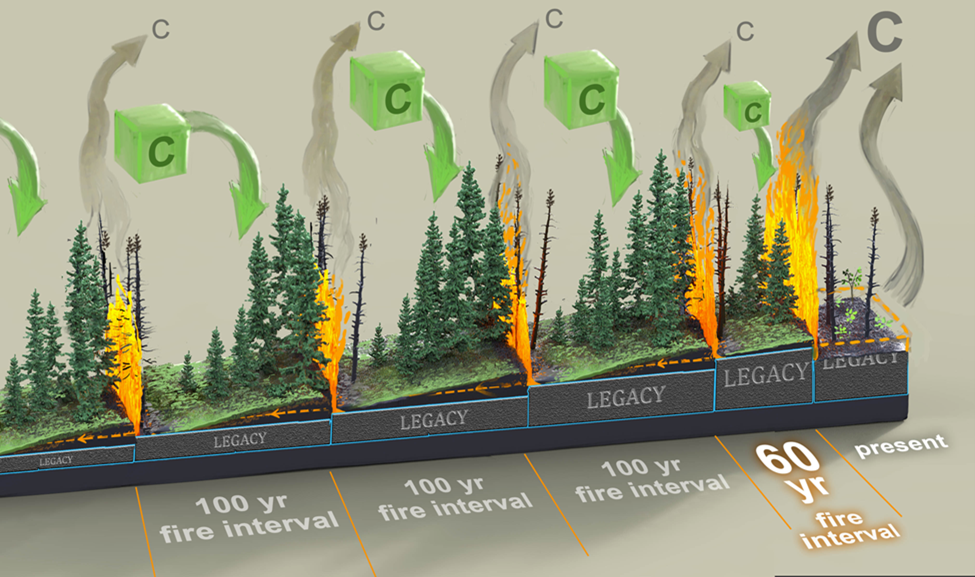
Figure 1. Successional cycles of fire disturbance and recovery in black spruce show the accumulation of soil C legacies over time. Changes to the fire regime that increase C loss from severe fires and reduce the time span of ecosystem recovery remove soil legacies and create the potential for new successional trajectories to emerge. Fig. by V. Leshyk, NAU-ECOSS.
How do black spruce ecosystem legacies and post-fire climate conditions impact successional trajectories?
Our research shows that when wildfires burn too deeply or too often, they disrupt the material legacies of the soil organic layer and its microbial communities that are essential for seedling establishment. This loss often leads to a shift from black spruce (Picea mariana) to deciduous dominance or even regeneration failure. Through a growing network of post-fire study sites across Interior Alaska, we are examining how fire severity, fire frequency, and post-fire climate interact to determine whether black spruce can re-establish or whether new successional trajectories emerge.
So far, our surveys of more than 800 plots across multiple fire scars and fire years reveal that short-interval reburns and overwintering fires are particularly disruptive. These fires burn deeply into the soil organic layer, expose mineral soil, and increase the likelihood of a transition to deciduous forests or regeneration failure. Meanwhile, early microbial findings indicate that while ectomycorrhizal colonization varies among species, changes in soil fungal communities may also contribute to regeneration failure under more intense fire regimes. Together, these results show that intensifying fire regimes can alter the trajectory of Interior Alaska’s boreal forests. As we expand our site network and track ecosystem responses over time, we gain clearer insight into where and why black spruce resilience to wildfire is being lost, and what this means for the future of northern boreal forest ecosystems.
How do the information legacies of regeneration strategies interact with wildfire and climate to drive alternative successional trajectories?
Regeneration patterns of deciduous species, such as Alaska paper birch (Betula neoalaskana) and trembling aspen (Populus tremuloides), or white spruce (Picea glauca) following wildfire depend on a different set of material and information legacies than black spruce. White spruce regeneration depends on infrequent climate-driven masting events that must coincide with fire years, while deciduous species like birch and aspen primarily resprout from root suckers. Understanding the key mechanisms that determine the resilience and stability of these alternative community types is essential for predicting future forest dynamics.
Our work shows that deciduous-dominated stands are highly resilient to wildfire: every stand that was dominated by deciduous trees before fire remained so after fire. Even when deciduous species made up as little as 10–15% of the pre-fire forest, they often became dominant after burning. This strong hysteresis means that fire-driven shifts from spruce to deciduous forests are likely to persist and reshape boreal landscapes over the long term. We have been monitoring seed traps across a core set of seven sites and five tree species. Continuous data from these sites extending back to 1969 will allow us to link patterns of tree recruitment to seed availability in the context of interannual climate variability.
What are the ecosystem consequences of alternative successional trajectories?
Shifts from spruce to deciduous-dominated forests will have important consequences for biotic communities and ecosystem processes. Our work shows that deciduous stands support faster nutrient cycling and decomposition, limit long-term soil carbon accumulation, and alter plant–soil–microbial feedbacks that help maintain these new forest states. To understand how these changes unfold over time, we monitor overstory and understory vegetation in sites that burned in 2004 and are now following different post-fire successional trajectories. We are now pairing post-fire vegetation changes with measurements of soil carbon quantity and radiocarbon signatures to evaluate carbon accumulation and turnover across spruce, mixed, open, and deciduous-dominated trajectories. By integrating these post-fire observations with the RSN+ chronosequence, we are quantifying how nitrogen and phosphorus cycling shift as forests transition from spruce dominance to alternative stable states.
How have humans historically modified the boreal fire regime, and how can this inform current fire and fuels management?
Fire has been an important part of boreal landscapes in Interior Alaska for millennia. It has been both a natural disturbance and a land management tool used by Alaska Native Peoples for travel, hunting, communication, and fuel reduction. Recognizing the long history of Indigenous fire stewardship is essential for informing modern approaches that protect communities while supporting ecosystem health.
Today, fuel treatments are one of the primary strategies for reducing wildfire risk near infrastructure, yet conventional fuel breaks come with ecological and social trade-offs. To help broaden their benefits and acceptance, we worked with land managers, scientists, and community members to co-develop fuel breaks with co-benefits. One of these approaches involves converting highly flammable black spruce stands to less flammable, deciduous-dominated forests that can still reduce wildifre risks to communities and infrastructure while enhancing local ecological and cultural values.
We have established experimental sites to test the effectiveness of different treatments (seed addition, seedling planting, nutrient amendments, and targeted soil exposure) to promote deciduous regeneration after treatment. Early results highlight the importance of mineral soil exposure and improved nutrient availability for conversion. Alongside field trials, we are using simulation models to explore how fuel treatments may evolve under future climate scenarios and how they influence wildfire behavior and long-term successional trajectories.
The Wildfire Working Group works collaboratively across disciplines, management partners, and Indigenous knowledge holders to connect post-fire regeneration dynamics, ecosystem feedbacks, and fuel management strategies. Together, our work shows that changing fire regimes are driving shifts in boreal forest structure and function with important implications for northern communities and the global climate system. Our integrated approach ensures that our science advances understanding of boreal ecosystem dynamics in response to intensifying fire regimes.
- Interacting effects of increasing Wildfire severity and Abrupt permafrost Thaw on the Carbon balance of High-latitude ecosystems (WATCH): Walker XJ (PI), Mack MC, Schuur EAG, Leigh MB, Goralnik L. National Science Foundation. ARCSS-Arctic System Science
- Impacts of fire severity, permafrost thaw, and succession on the boreal forest carbon balance: Walker XJ (PI), Mack MC, Schuur EAG. Bureau of Land Management
- Drivers and impacts of reburning in boreal forest Ecosystems (DIRE): Walker XJ (PI), Berner LT, Goetz SA, Johnstone JF, Mack MC, Rogers BM (Co-Is), Baltzer J, Jean M, Hollingsworth T. (Collaborators). National Aeronautics and Space Administration. Terrestrial Ecology.
- Collaborative Research: Increasing wildfires and the loss of legacy carbon from boreal and tundra ecosystems: Walker XJ (PI), Mack MC, Rogers BM. National Science Foundation. ANS-Arctic Natural Sciences
- Collaborative research: Climate warming and increasing wildfire in the boreal forests of Northwestern North America: Will vegetation change slow the feedback? : Mack MC (PI), Walker XJ, Goetz SJ, Berner LT, Foster AC, Hansen WD, Rogers BM. National Science Foundation. ARCSS-Arctic System Science
- Collaborative Research: Socio-ecological considerations for sustainable fuel treatments to reduce wildfire risk (SAFRR): Schmidt JI (PI), Mack MC, Walker XJ, Little JM, Brenkert-Smith H, Berman MD, Keirn F. National Science Foundation. NNA-Navigating the New Arctic
- The Past, Present and Future of Boreal Fire Feedbacks: Buma B, Higuera C, Hoffman C, Chapman M, Hayes K, NSF 2215120
- Two fires, one stone: Identifying co-benefits of optimizing Alaska fire management for climate adaptation: Hayes K, AK CASC
- Investigating fire-biotic disturbance interactions and their sensitivity to climate in the North American boreal biome: Hayes K, Hansen W, Johnstone J. NSF 2219248
- Betsy Black, MS student, NAU
- Ellery Vaugh, MS student, NAU
- Melissa Boyd, Research Associate, NAU
- Samantha Miller, Research Associate, NAU
- Felecia Amundsen, MS student, NAU
- Jeremy Forsythe, Research Associate, NAU
- Kirstin Bauck, Nasa Space Grant Undergraduate Internship, NAU
- Tabytha Clearwater, PhD student, UO
- Abby Hay, PhD student, NAU
- Nicholas Link, PhD student, NAU
- Anastasia Pulak, PhD student, NAU
- Bjorn Larson, PhD student, NAU
- Savannah Wilson, MS student, NAU
- Matthew Beherns, MS student, NAU
- Andrrew Haverdink, REU, UAF and NAU
- Becca Olson, MS student, UAF
- Maria Beaulieu, REU, UAF
- Emma Lin, REU, UAF
- Maura Grahek, Undergraduate Researcher, UAF
- Paige Paulsen, MS student, UAF
- Olivia Hajek, Postdoc, UAF


