 B
B
Engagement Working Group
Education, Outreach & Inreach

Teaching students about green-down, a protocol used to monitor the changes in color of leaves during autumn.

Youth at a Fostering Science camp cross a bridge during a hike in Denali National Park and Preserve. Photo: C. McCaa

Students learn to track leaf phenology through the Schoolyard LTER program.

Teachers share gesture drawings during an online workshop.

A student is guided through a geospatial learning exercise.
Collaborators

Dr. Elena Sparrow
Education Outreach Director, Research Professor
International Arctic Research Center - University of Alaska Fairbanks

Dr. Katie Spellman
Associate Professor, Education and Outreach Co-Director
International Arctic Research Center & Department of Natural Resources and Environment - University of Alaska Fairbanks

Dr. Christa Mulder
Professor of Plant Ecology
University of Alaska Fairbanks

Emily Sousa
Education Specialist
International Arctic Research Center - University of Alaska Fairbanks

Joel Eklof
Assistant Professor
Environmental Studies and Sciences Program - University of Puget Sound

John Smelter
Research Assistant Professor
International Arctic Research Center - University of Alaska Fairbanks

Kara Kornhauser
Camps Coordinator
International Arctic Research Center - University of Alaska Fairbanks
Our mission is to include everyone in learning about and contributing to knowledge of the boreal forest, from students to scientists to Elders and community members. All of our activities are rooted in the boreal forest. Our STEM education and engagement programs form the basis of our research on how people learn and share knowledge.
Our collaborative team hosts programming in the following primary areas:
Research training opportunities
We offer research training opportunities for undergraduate students, graduate students, and K-12 teachers through Research Experiences for Undergraduates (REU), Graduate Research Assistantships, Research Experience for Teachers (RET), and a research intensive for first-generation underrepresented college students. LTER-associated faculty and graduate students often mentor high school student research projects through programs such as the Rural High School Institute Summer Program, the NSF Established Program to Stimulate Competitive Research (EPSCoR), and the Alaska Statewide High School Science Symposium We also regularly offer workshops for students, faculty, and collaborators in topics related to boreal forest ecology, culturally relevant inquiry,; and ethical research partnerships.
Community and Citizen Science
Bonanza Creek LTER is committed to engaging diverse Alaskan communities directly in the research process in a variety of ways from data collection activities to community-led scientific investigations. For example, in the Winterberry Citizen Science Program, K-12 youth and adults from communities throughout Alaska investigated how shifting seasons could affect when berries are available to animals and people.. In another example, we use the Arctic and Earth SIGNs program to help community teams to generate their own community-centered research question and contribute data to larger regional research efforts.
Teacher and Community Member Professional Development Courses
We offer an annual summer training workshop that focuses on braiding Indigenous Knowledge and environmental monitoring and scientific investigations using Global Learning and Observations to Benefit the Environment (GLOBE) protocols or other citizen science protocols developed by Bonanza Creek LTER researchers. A year-long course called “Climate Change and My Community” trains teachers, informal science educators, tribal environmental program coordinators, youth leaders, and community members to address a climate change-related issue in their community using both long-term ecological monitoring and indigenous knowledge systems. Shorter mini-workshop courses are offered through school districts or other organizations.
Direct K-16 Youth Programming
We also provide direct youth programming through our Fostering Science program for youth who are in care of the state, day trips for K-16 classes, classroom/youth group visits by BNZ scientists, and public, youth or family events. Other activities include day trips for K-16 classes to BNZ field sites, classroom visits by BNZ scientists, and tables or activities at educational events.
Within each of our programs, we also conduct research on how youth and adults come to think of themselves as someone who can understand and use science about the boreal forest. We often experiment with the program design elements and measure the learning outcomes. We share our results in talks and publications so others can learn from our work. Some sample of the types of questions we ask and the papers we publish are below:
What do educators and community leaders in Alaska want and need for citizen-science based climate change education programs?
Spellman et al. (2018) assessed the interests, desired benefits, and support needs of formal teachers, informal educators (like 4-H leaders), and community members in rural and Indigenous Alaska to inform the design of citizen science–based climate change learning programs. They found that locally relevant climate challenges motivated all audiences. The research further indicated that all audiences wanted opportunities for youth to engage with culturally responsive climate science and NASA/GLOBE citizen science, but that they needed training, resources, and collaboration supports to successfully implement such programs. These results guided development of the Arctic and Earth SIGNs model, emphasizing community-school collaboration, inclusion of elders and scientists, culturally grounded curricula, and action-oriented stewardship linked to citizen science data.
Does art-science integration through storytelling influence science learning and youth's sense of environmental agency?
Spellman, Cost and Villano (2021) tested a scenario-storytelling workshop paired with a youth-focused wild berry community and citizen science program and found that this approach helped participants apply their own data to imagine future outcomes and potential stewardship actions. The method fostered key sustainability thinking skills—such as systems, futures, and strategic thinking—and helped many youth groups pursue continued monitoring, share results, and engage in additional community science activities. However, fewer groups translated their scenario ideas into concrete stewardship actions, suggesting further practice is needed to strengthen youths’ sense of themselves as agents of environmental change.
Does the level of co-creation of citizen and community science projects influence the outcomes for the youth involved?
In Clement, Spellman et al. (2023), the authors compared two community and citizen science (CCS) models—contributory versus co-created—to assess how youth participation influenced their science self-efficacy and interest across two Alaska projects. Youth in co-created CCS projects, where they had greater decision-making power in the scientific process, reflected more frequently and deeply on increases in their confidence to do science, while science interest grew for youth in both models regardless of design. These findings suggest that redistributing power and agency to youth in CCS can enhance their science self-efficacy, and that participation in authentic CCS projects broadly engages and excites youth about science learning.
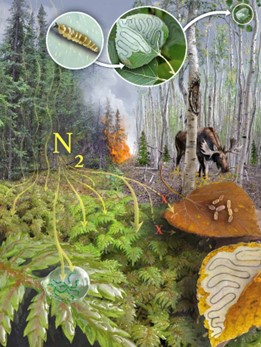
Greendown Art and Athabascan Values
Our research in Engagement crosses and disrupts disciplinary bounds to create a more holistic understanding of our boreal ecosystem. In particular, we seek to understand the impact of community collaborations on research, education, and data collection. By utilizing community science and fostering the next generation of leadership, the Engagement group impacts how our communities interact with and understand our ecosystems.
Much of our work is supported through the National Science Foundation and NASA through other grant funded projects and cooperative agreements. The Arctic and Earth SIGNs project (NASA award NNX16AC52A) and the Association of Interior Native Educators are major partners for nearly all of our BNZ education programs.
- Gabe Abreu-Vigil, Oregon State
- Lindsey Parkinson, UAF


