 B
B
Consumers Working Group

Sampling canopy aspen leaves to quantify herbivore damage. Photo: Diane Wagner

The larvae of the aspen leaf miner moth feed on the outer cell layer of the aspen leaf, causing a pale serpentine mine. Photo: Diane Wagner

The aspen leaf miner is a tiny moth that lays its eggs on aspen leaves just after the spring budbreak. Photo: Alec Milbourne

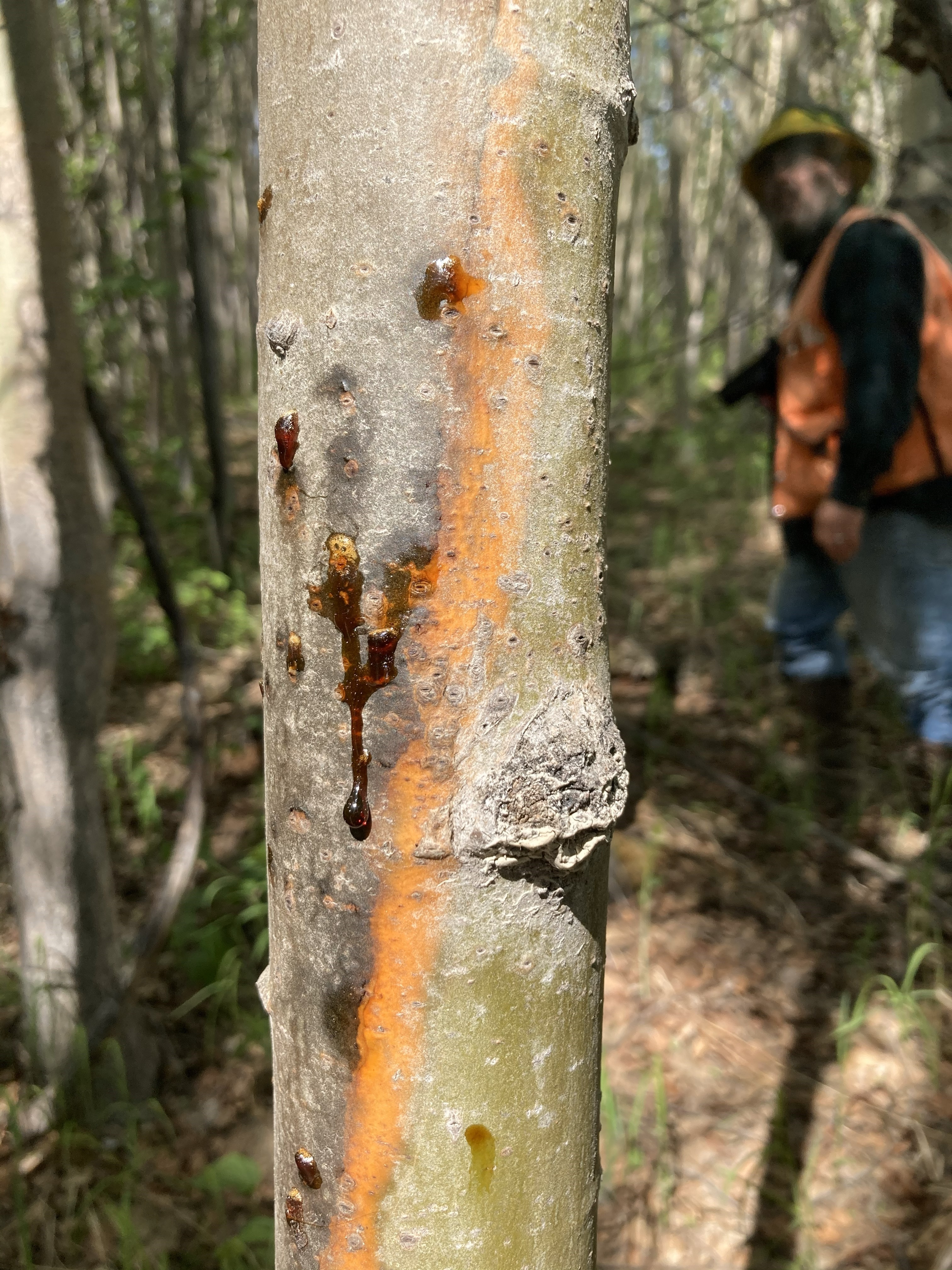
Sometimes a ridge forms on aspen’s trunk because as a response to infection. Photo: Jorda Kovash

A tree trunk with a smiley face makes researchers chuckle as they assess aspen for presence of canker. Photo: Ursel Schütte

A yearly pest & pathogen workshop at BNZ gives an opportunity to learn about common forest pests and diseases in Interior Alaska. Photo: Jill Johnstone
Lead

Ursel Schütte
Research Scientist
University of Alaska Fairbanks
Collaborators

Jill Johnstone
Research Scientist
University of Alaska Fairbanks and Yukon University Research Centre

Mary Beth Leigh
Professor
University of Alaska Fairbanks

Diane Wagner
Professor
University of Alaska Fairbanks

Pat Doak
Associate Professor of Ecology
University of Alaska Fairbanks

Katherine Hayes
Assistant Professor of Forest Ecology
University of Alaska Fairbanks

Hillary Cooper
Research Associate
Northern Arizona University

Logan Berner
Assistant Research Professor
Northern Arizona University

Philip Manlick
Research Wildlife Biologist
U.S. Forest Service Pacific Northwest Research Station
The Consumers Working Group investigates how organisms that eat plants or cause disease are shaping the forest ecosystems we see around us. We use trembling aspen (Populus tremuloides) and its consumers as a model system to investigate the cascading effects of insect herbivores and fungal pathogens on ecosystem processes and forest succession. Our results help to better understand how population dynamics and consumer activities interact with climate change to shape ecological succession. We are particularly interested in how forest consumers may alter the pace and direction of forest succession, including their role in tipping the balance between deciduous or conifer tree dominance.
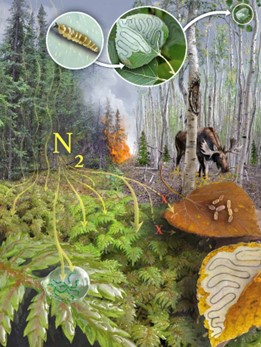
How has the aspen leaf miner varied in abundance during its extended outbreak over the past 20 years? How has this affected aspen trees in Interior Alaska?
Alaska’s boreal forest is experiencing an ongoing outbreak of the aspen leaf miner, a small moth. Aspen leaf miner larvae feed only on a single, outer cell layer of the leaf. Despite the limited extent of the leaf tissue damage it causes, this herbivore has wide-ranging physiological effects on aspen trees, slowing tree growth and increasing mortality. At a leaf level, mining damage reduces photosynthesis and increases water loss. Ongoing work is exploring the role of leaf mining on aspen’s ability to manage critical nutrients. In particular we are asking whether leaf mining compromises the tree’s ability to reclaim and store nutrients such as nitrogen from leaves as they senesce in autumn.
We have monitored aspen leaf damage at fine scales for 19 years. We are currently using that long-term data set to better understand the mechanisms that have allowed this outbreak to persist. We have modelled the relative influence of insect population dynamics, natural enemies, plant traits, and environmental conditions on annual levels of leaf damage. Our results indicate that population processes, such as survival to adulthood in the previous year, are the dominant drivers of herbivory, while predators and abiotic factors play more limited roles. Aggressive and often lethal competition among larvae within leaves limits leaf damage and preserves leaf function, likely prolonging the outbreak. These findings highlight the importance of fine-scale biological processes in structuring patterns of forest damage in aspen stands in Interior Alaska.
What factors affect aspen susceptibility to running canker disease?
An emerging fungal pathogen (Neodothiora populina) has been causing widespread mortality in trembling aspen in Alaska. Together with partners in the Bureau of Land Management, National Park Service, and U.S. Forest Service, we are assessing how the presence of the disease is changing across Alaska. Initial findings indicate that mortality in aspen due to the disease remains high.
In order to understand how aspen may resist or succumb to this canker disease, we are actively investigating aspen’s genetic response to the fungal infection and how it is impacted by other stressors due to leaf miner herbivory (carbon and water stress) and drought due to climate change. So far aspen shows a strong genetic response to aspen running canker with large differences in gene expression in smaller- versus larger-diameter trees. Plant metabolic pathways showing changes in gene expression include those involved in pathogen recognition, reinforcing structural barriers (which may help wall off the disease), as well as plant hormone production.
Curious about aspen leaf miner?
- Boyd, M.A., Berner, L.T., Foster, A.C., Goetz, S.J., Rogers, B.M., Walker, X.J., and Mack, M.C. 2021. Historic declines in growth portend trembling aspen death during a contemporary leaf miner outbreak in Alaska. Ecosphere, 12 (6). 085010. https://doi.org/10.1002/ECS2.3569
- Boyd, M.A., Berner, L.T.,, Doak P., Goetz S.C., Rogers B.M., Wagner D., Walker X.J. and Mack M.C. 2019. Impacts of climate and insect herbivory on productivity and physiology of trembling aspen (Populus tremuloides) in Alaskan boreal forests. Environmental Research Letter 14(8)doi:10.1088/1748-9326/ab215f
- Doak P., Wagner D. 2015. The role of interference competition in a sustained population outbreak of the aspen leaf miner in Alaska. Basic and Applied Ecology 16(5): 434-442. https://doi.org/10.1016/j.baae.2015.04.001.
- Wagner D., Wheeler J.M., Burr S.J. 2020. The leaf miner Phyllocnistis populiella negatively impacts water relations in aspen. Tree Physiology. 40(5):580-590. doi: 10.1093/treephys/tpz109. PMID: 31728531
Curious about the aspen running canker disease and the fungal pathogen?
- Ruess R.W., Winton L.M., Adams G.C. 2021. Widespread mortality of trembling aspen (Populus tremuloides) throughout interior Alaskan boreal forests resulting from a novel canker disease. PLoS One. 16(6):e0253996. doi: 10.1371/journal.pone.0253996
- Winton, L. M., Adams, G. C., and Ruess, R. W. 2022. Determining the novel pathogen Neodothiora populina as the causal agent of the aspen running canker disease in Alaska. Canadian Journal of Plant Pathology, 44(1), 103–114. https://doi.org/10.1080/07060661.2021.1952487
- Schütte U.M.E., Wages M., Buechlein A., Kovash J.P., Wrenn D.C., Smrhova T., Zubrova A., Rusch D.B., Winton L.M., Adams G.C., Ruess R.W., Leigh M.B., Drown D.M. 2025. Draft Genome data including functional annotation of an emerging fungal pathogen Neodothiora populina causing a canker disease of trembling aspen in Interior Alaska. PhytoFront. 5(1):90-93. doi:10.1094/PHYTOFR-09-24-0101-A
What is the role of climate in shaping how plant consumers affect tree growth and forest communities?
Despite variability in the abundance of aspen leaf miner from year to year, our analysis of leaf miner damage to aspen leaves during the past two decades suggests a relatively minor role of climate in shaping leaf miner abundance and impacts on leaves. Ongoing work suggests a modest negative relationship between leaf mining damage and both the duration of deep winter cold and the duration of relatively warm periods between snow-out and budbreak. In addition, leaf miner impacts may interact with climate by increasing the vulnerability of aspen to drought stress.
The Consumer Working Group collaborates across disciplines, management partners, and indigenous people to assess how pests and pathogens in the boreal forest may influence forest health and succession. Working together, we are seeing that intensifying pests and pathogen pressure are adding additional stress on the few boreal tree species in Interior Alaska, likely impacting post-fire successional trajectories. Using an integrated approach allows us to improve our understanding of boreal ecosystem dynamics with increasing pest and pathogen pressure.
Aspen leaf miner related work
- D Wagner, P Doak, CR Petersen, J Johnstone, HF Cooper, M Mack; BNZ LTER
Aspen running canker work
- Impacts of drought and pest-associated carbon stress on the molecular mechanisms of resistance and susceptibility of trembling aspen to a fungal canker disease. UME Schütte, MB Leigh , RW Ruess, D Wagner, and L Winton, USDA McIntire-Stennis Cooperative Forestry Research Program
- Determining underlying genetic differences in trembling aspen associated with resistance or susceptibility to an emerging fungal canker disease. MB Leigh. Institutional Development Award from the National Institute of General Medical Sciences of the National Institutes of Health (NIH)
- Determining plant host defense mechanisms of trembling aspen to Neodothiora populina, a pathogen causing widespread mortality in trembling aspen in Interior Alaska. Institutional Development Award from the National Institute of General Medical Sciences of the National Institutes of Health (NIH)
- Utilizing forest inventory permanent plots for boreal forest disease detection and quantification of trembling aspen canker and Siberian alder canker. L Winton, Loretta, R Ruess , UME Schütte, and Mary Beth Leigh (subawardees). U.S. Forest Service
- Characterization of host immunity response in trembling aspen to a fungal pathogen causing widespread mortality across the boreal forest. UME Schütte, BLaST (NIH Common Fund, through the Office of Strategic Coordination, Office of the NIH Director)
Impact of climate change on consumers
- Mapping plant biomass distribution and change across the rapidly warming Arctic tundra biome. Logan Berner; NASA Early Career Investigator Program
- Climate warming and increasing wildfire in boreal forests: Can fire self-regulation mitigate the positive feedback? Michelle Mack; NSF Arctic System Science Program
- Mapping and modeling attributes of an arctic – boreal biome shift: Phase-3 applications within the ABoVE domain. Scott Goetz; NASA Terrestrial Ecology Program
With regards to aspen running canker
- Jorda Kovash
- Alec Milbourne
- Josephine Beauchamp
- Hannah Glesener
- Dr. Roger Ruess
- Dr. Loretta Winton
- Dr. Sydney Mullen
- Dr. Devin Drown
- Dr. Doug Rusch
- Dr. Ram Podicheti
- Dr. Jennifer Baltzer
- Dr. Colin Bonner
- Mackenzie Mihorean
- Dr. Greg Thorpe
With regards to trophic interactions (aspen leaf miner)
- Melissa Boyd
- Russell Dennis
- Alec Milbourne
- Brent Mortensen
- Rachel Rombardo
- Giovanni Tundo
- Brian Young
- Jenifer Wheeler
- Dr. Stephen Burr
- Dr. Christopher Peterson
With regards to trophic interactions (willow leaf blotch miner)
- Brian Allman
- Mara Cummings
With regards to trophic interactions (other trophic interactions)
- Alexandria Wenninger
- Dr. Juha Honkaniemi
- Dr. Katharina Albrich
- Dr. Alix Conway
With regards to trophic interactions (lynx and snowshoe hare)
- Dr. Knut Kielland
With regards to trophic interactions (food webs)
- Dr. Seth Newsome
- Dr. Amanda Koltz
- Dr. Ryan Stephens


